.png)
Conferences are sold on ideas: the panels, the demos, the hallway conversations that turn into partnerships. But they also mean early mornings, packed schedules, evenings that run longer than planned, and a body that goes into a stress mode. Frequent conference-goers know the feeling: you fly home somehow both energised and exhausted, having slept badly, walked more than usual, and eaten at times that made no biological sense. But what does a conference actually do to you in measurable terms? At HLTH Europe in Amsterdam this June, Thryve set out to answer exactly that with real wearable data, collected voluntarily by attendees and analyzed anonymously.
Our team was happy to attend the conference, meet with the best innovators in the European healthcare industry, and take part in conversations on what the future of healthcare looks like, powered by data and AI.
And on Wednesday, June 17th, Thryve sponsored the Re//CHARGE afterparty at the Chicago Social Club. After days of keynotes, meetings, and networking, we brought together a selected crowd to unwind and recharge off-work – just music, drinks, and movement.
Over the course of the event, attendees were invited to take the Thryve Quick Health Check app, getting a snapshot of their health, powered by wearables and AI analytics. Through the app, we analyzed their historical wearable data, giving us both a pre-conference baseline and a real-time view of what the conference was doing to their bodies.
We also extended data collection into the evening, analysing how attendees' health signals changed during RE//CHARGE, the after-party we hosted.
Overall, attendees connected their wearables and completed a health check. What their data showed was equal parts fascinating and unsurprising to anyone who has ever crawled home from a health tech conference.
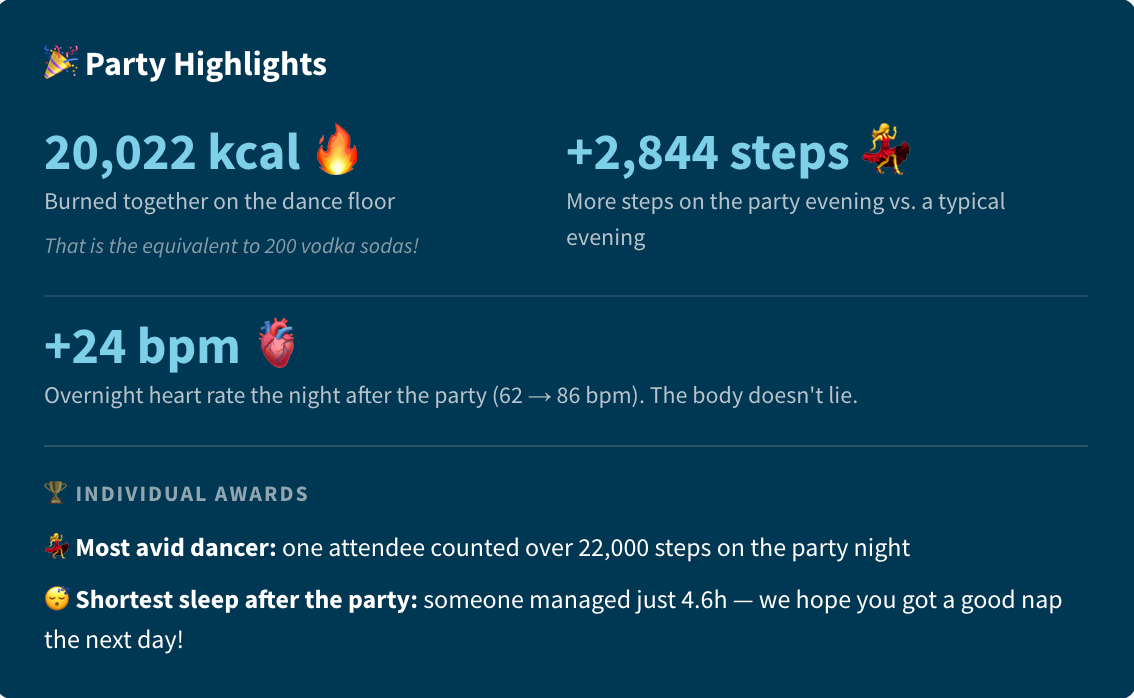
After we collected the data, we anonymised it to tell a clear story across three dimensions: movement, sleep, and recovery.
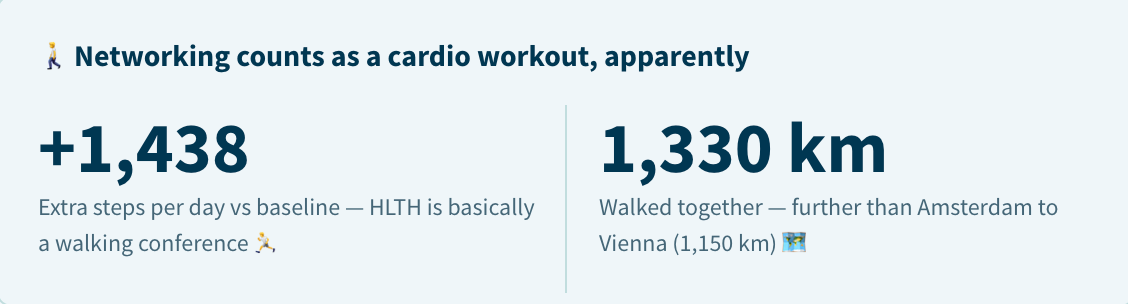
Conference days pushed average daily steps to 9,686, marking a 19% jump over the two-week baseline of 8,131. Across all connected attendees, that adds up to 1,343 km walked together over the conference period, further than the distance from Amsterdam to Vienna. The party night itself was even more remarkable, with one attendee clocking over 22,000 steps without leaving the dance floor. In headline numbers:

On conference nights, average sleep dropped from a baseline of 6.8 hours to 6.3 hours. On the party night, it fell further to 5.9 hours, as people went to bed around 01:54 on average, 1.5 hours later than usual, and only managed to sleep in until 08:16. The shortest night logged was just 4.6 hours, and two-thirds of attendees slept under six hours on at least one conference night.
We are here to remind you that sleep regularity and continuity are among the most influential factors when it comes to our longevity. Having a late night here and there won’t reduce your lifespan, but it is important to have a good sleeping schedule. We broke down the details of how sleep affects us in the blog post.
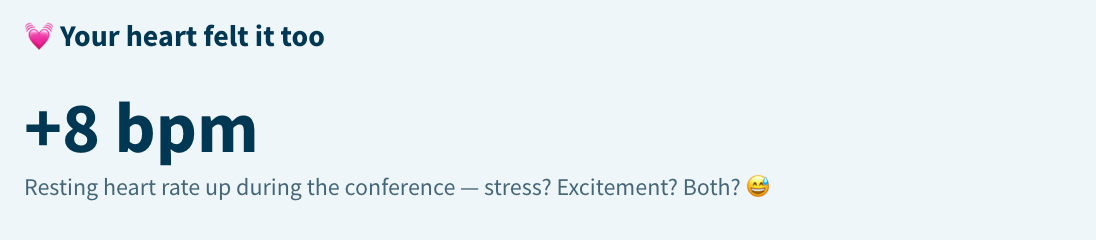
Recovery signals were the most telling of all. Key figures:
This kind of elevated overnight heart rate, driven by late physical activity and, in all likelihood, some alcohol intake, is a well-known signal that the body is working overtime instead of recovering.
It would be easy to file this under "fun experiment" and move on. But there's something more interesting happening here.
The data was collected passively. Attendees connected their wearables once, went about their conference, and Thryve did the rest, aggregating, anonymising, and surfacing insights that gave a genuine before-and-after picture of the event. No manual logging. No surveys. No self-reporting bias. Just the signal your body was already generating, made clear by us.
This is exactly what Thryve is built to do at scale. We work with health insurers, employers, and digital health platforms that want to understand the real-world health behaviour of their users, not what people say they do, but what their devices actually record. The HLTH Europe experiment was a small, live demonstration of that capability: connect a cohort, establish a baseline, and track meaningful change in real time.
You can see that the insights are directional rather than clinical. This wasn't a study; it was a conference, but the signal is clear enough to be genuinely useful. Elevated resting heart rate, shortened sleep, and increased physical activity during a multi-day event are exactly the kind of markers that matter to anyone building population-level health programmes.
Our team had a great time at HLTH Europe this year! We are so happy to contribute to the conference by combining our quick health check program with a small contribution to Amsterdam's nightlife. If you were there, your wearable probably remembers it better than you do.
For Thryve, the biggest takeaway wasn't the data entry points. It was the confirmation that connected health data, even from a small cohort over a short window, tells a coherent and actionable story. The gap between what people know about their health and what their devices know is still enormous, and closing it is the whole point.
The quick health check is just the tip of the iceberg! If you want to see what Thryve's health data infrastructure can do for your platform or programme, Book a Demo!
Free download of Thryve’s Quick Health Check app in App Store and Google Play.
Data collected from 46 attendees who connected their wearables via the Thryve Quick Health Check app. All data is aggregated and anonymised. Baseline period: June 1–14; conference: June 15–18, 2026. Heart-rate elevation is a physiological signal and not a measurement of alcohol intake. The health check app is a demonstration of Thryve's data integration and analytics capabilities and is not a Thryve product or medical assessment.


