.png)
Recovery does not end when a patient leaves the hospital. In many cases, that is when the most fragile part of the patient’s journey actually begins. After surgeries, specialist consultations, or major medical events, patients are often left to manage recovery largely on their own.
This creates a range of common post-care problems:
The issue is not necessarily the lack of healthcare services, but rather low continuous engagement afterwards. Most healthcare systems are still designed around isolated interactions rather than ongoing recovery support. Once a patient leaves the clinic, communication often becomes reactive instead of proactive.
This challenge became the focus of HeyMo, a project developed during the Alan x Mistral AI Hackathon in Paris. Built by Gabriel Leulmi, Lenny Napieraj, Max Penso, and Mohammad Mujtaba, the solution won the ElevenLabs Challenge by exploring how voice AI and wearable data could transform post-care follow-up into a more continuous and human-centered experience.
This is exactly where platforms like Thryve become critical. By aggregating and standardizing biometric data across hundreds of wearable integrations, Thryve enables AI systems to work with continuous, harmonized, and trustworthy health insights instead of disconnected data streams. Without this infrastructure layer, proactive healthcare experiences powered by AI simply cannot function reliably at scale.
Despite all the advances in digital healthcare, most patient follow-up systems still rely heavily on patients managing recovery themselves. After leaving the hospital or clinic, individuals are expected to:
In practice, this creates major gaps in treatment monitoring. Most healthcare systems only react once symptoms escalate or patients actively report a problem. By that point, recovery complications, stress, or disengagement may already have intensified.
Believe it or not, many healthcare issues have the same bottleneck: wearables already capture continuous recovery signals such as sleep disruption, reduced activity, elevated resting heart rate, or prolonged stress patterns. But without infrastructure layers like Thryve that standardize and operationalize these biometric streams, these signals remain fragmented and difficult to act upon in real time.
For many patients, the period after treatment can feel surprisingly isolated. Once a surgery or consultation is completed, communication often drops significantly until the next scheduled interaction.
This creates an invisible gap where:
While chatbots and support portals exist, they still depend on patients initiating the conversation themselves. During recovery, exhaustion, anxiety, or cognitive overload often reduce engagement exactly when support is most needed.
The result is a fundamental limitation in modern healthcare communication: systems still depend too heavily on patients taking the first step, instead of proactively recognizing when intervention may be necessary.
The core idea behind HeyMo turns the tables: instead of waiting for patients to ask for help, the healthcare system should be able to proactively reach out when support may be needed.
Rather than relying on static reminders or passive dashboards, HeyMo combined voice AI, wearable data, and contextual healthcare information to create a more continuous and personalized recovery experience. The system was designed to follow up with patients after medical events, understand how recovery was progressing, and guide them toward the right next steps when necessary.
This approach was only possible because reliable wearable infrastructure already existed beneath the AI layer. Through Thryve, the system could access harmonized biometric signals such as sleep, activity, and resting heart rate across multiple wearable ecosystems, transforming fragmented sensor data into actionable health context.
Instead of generic check-ins, HeyMo could create personalized follow-up journeys grounded in real physiological and behavioral patterns. If wearable signals suggested reduced recovery or elevated stress, the conversation adapted dynamically to the patient’s situation.
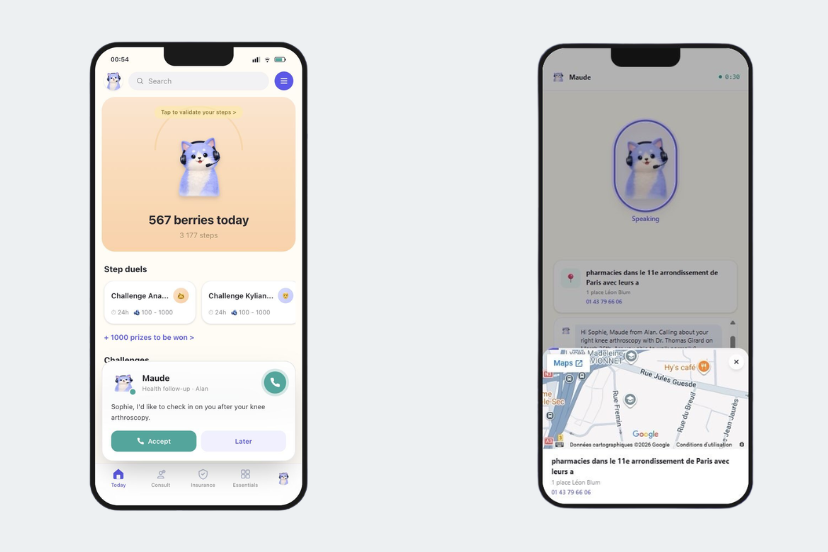
At the center of the project was Maude, an AI-powered voice agent designed to proactively follow up with patients after medical events such as surgeries, hospital visits, or specialist consultations. Instead of functioning like a generic chatbot, Maude operated with real patient context and continuously updated health insights.
During conversations, the system combined:
This was made possible through Thryve’s API, which enabled continuous access to harmonized biometric data across multiple wearable ecosystems. Rather than working with disconnected sensor streams, the AI could rely on standardized and interpretable health signals in real time.
HeyMo used wearable biomarkers such as:
Instead of reacting to isolated measurements, the AI analyzed trends over time to create more grounded and contextual interactions. This allowed Maude to ask questions that felt personalized and clinically relevant rather than scripted.
For example:
“I noticed your sleep dropped last night, is that linked to pain?”
This longitudinal context was critical. A single poor night of sleep means very little on its own, but sustained deviations in recovery, activity, or resting heart rate can reveal meaningful changes in patient well-being. By leveraging Thryve’s harmonized wearable data layer, the system could interpret broader recovery patterns rather than disconnected daily metrics.
The experience was designed to move beyond conversations and enable real-time action during the call itself.
While speaking with the patient, Maude could surface:
After the call, patients received an interactive recap where every suggested action remained accessible. This included AI-powered doctor chat functionality with full conversational context already attached, eliminating the need for patients to repeatedly explain their situation.
The result was a more continuous and connected patient journey where wearable insights, AI reasoning, and healthcare workflows could work together in real time.
Most healthcare systems still operate around isolated interactions: a surgery, a consultation, a discharge, a follow-up appointment. But recovery does not happen in snapshots. Improvement, deterioration, stress, and complications unfold continuously between those moments.
Modern wearables make it possible to monitor recovery in real time through passive biometric signals such as:
The critical shift is not simply data collection, but the ability to operationalize this data reliably across ecosystems. Fragmented wearable signals become standardized, longitudinal health insights that AI systems can actually interpret and act upon. This creates the foundation for more proactive healthcare models where intervention can happen earlier and with greater context.
During recovery, patients often lack the energy or motivation to navigate apps, type messages, or manually search for support. Voice changes that dynamic by reducing friction and creating a more natural interaction experience.
Instead of asking patients to constantly monitor dashboards themselves, conversational AI can proactively engage users in a way that feels more immediate, supportive, and human.
The broader implication is significant: the future of preventive healthcare may depend on proactive systems that combine continuous wearable intelligence, conversational AI, and personalized follow-up journeys built on reliable health data infrastructure.
The project depended on continuous access to reliable wearable health data. Without a standardized biometric infrastructure, the system would not have been able to generate meaningful recovery insights or personalized patient follow-up.
This is where Thryve became a foundational part of the HeyMo. By aggregating wearable data across multiple ecosystems and transforming fragmented sensor streams into harmonized biometric models, Thryve enabled the AI system to work with consistent and interpretable health signals in real time.
The infrastructure also enabled access to historical wearable insights, making it possible to identify longer-term recovery patterns instead of isolated daily fluctuations. This longitudinal context was critical for creating more intelligent and proactive patient interactions.
With Thryve, the team gained access to:
By removing the complexity of fragmented wearable integrations, Thryve enabled the team to focus entirely on building proactive healthcare experiences powered by continuous health insights.
As projects like HeyMo demonstrate, the future of preventive care may depend on healthcare systems that do not wait for patients to ask for help, but can recognize when support is needed and proactively reach out first.
If your health solution is ready to reach out first too, Thryve provides the wearable infrastructure to make it possible.

Friedrich Lämmel is CEO of Thryve, the plug & play API to access and understand 24/7 health data from wearables and medical trackers. Prior to Thryve, he built eCommerce platforms with billions of turnover and worked and lived in several countries in Europe and beyond.


.png)
.png)
.png)